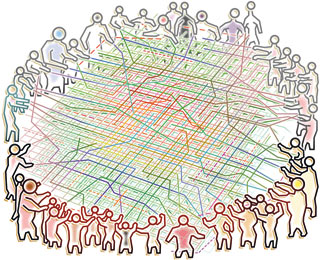
I have a bit of experience with turning disparate and occasionally disconnected information into useful analysis. It's hard. It takes a lot of work and three very rare things: a the ability to make and defend a thesis, a penchant for lateral thinking, and a great data storage/retrieval methodology. Yes, there are other qualities that make the production of reports and analysis better, such as expertise in one's craft, profound subject-matter knowledge, or broad-ranging interests; but starting from those three basic things, one can maintain a good data-synthesis capacity. In most organisations that do this kind of data-synthesis, they rely on individuals to put all this together. Perhaps individuals with small teams, but the typical "producer" of analysis is the analyst - a person. One single person. Bureaucracies and think tanks are constantly in need of more "processor power" to deal with all the information they collect and have to report on. Collection itself is onerous - requiring its own specific and hard-to-find skillsets - let alone the ability to synthesise data together into a useful piece of information. There will always be more data around than the group assigned to processing it will be able to process.
For example, in a classical intelligence operation, assets are run by an operator. The assets are key contacts that the operator uses to gather information to report back to either a handler or his operational unit at headquarters. The operations unit collates and synthesises the work of several operators into briefs and assessments that are then passed to a strategic unit. The strategic unit produces more broad or deep situational reports based on the briefs and assessments from the operational unit. This hierarchy of information gathering requires that at each level, the information gathered becomes more compact and dense. This requires skilled officers at every level to accomplish, and each level is mission-critical. Given the fallibility of humans, the efficiency of a trim organisation can occasionally be a weakness, and when possible, overlap and numbers help overcome this problem. With numbers comes the problem of a greater amount of information to handle, and we are back again at the beginning: the more data you have, the more people you need to parse it. Who better to collect and parse that information than the people you're parsing it for? The people.
PEOPLE POWER
Feedback: crowdsourcing monitoring of government initiatives
Feedback applies to everything a government does to maintain law, order, and a free flow of goods and people within and through its borders. Things like food safety inspections, water quality indexes, air pollution sampling, ice cores, soil monitoring, and even stuff as mundane as traffic flow analysis are all examples of data collection that the government performs to provide feedbacks for its initiatives. Every department of the government collects and maintains catalogues of indices and datapoints to better maintain its programs and make certain the public purse is being employed responsibly. All that data gets fed into huge and broad-ranging analysis to assist in steering the ship of state. That's why there's an entire department of the government called StatsCan, and it's a lot more important than people give it credit for. Monitoring what the government does is almost like a double expenditure on a program: not only does a department have to pay to implement a program, but they have to pay the administrative overhead to manage and measure its output. This is no small amount of money or manpower (expressed in "full time equivalents" or "FTEs").
It's important though, because fairness is expensive. Government must pay more for everything because it must be certain it acts without fear or favour. The process of establishing the need for an expenditure, securing budget for the expenditure, making a tender call, reviewing tenders, selecting a contractor, monitoring the performance of the contractor, assessing whether the final product meets specifications, and completing the contract (and yes, I left out a lot of steps there) must be reviewably fair, transparent, and equitable. Reviewably fair means there is a process established before the activity begins that explains how the process will proceed and why, and that all results of all steps of the process are recorded and judged as part of this established process. Transparent means that all stakeholders in the process must be given adequate and appropriate information for them to be able to take part in the process. Equitable means that no one stakeholder can have a privilege over any other stakeholder. That is, in a nutshell, what government has to do every time it does something. That means you don't simply pay for services, you pay for responsibility. That costs more than just services in the short run, but in the long run, actually costs less. A joke (from a country that shall remain nameless) explains why this is so:
"J", a member of the government of a (country that shall remain nameless) went to America to see how things were done. He visited the palatial mansion of a senator and asked the senator how he got so much money to buy such a lovely house. The senator took J to the porch and pointed to a bridge over the river. "You see that bridge?" said the senator, "I hired the contractors, got the money for double the value of the bridge from the treasury, paid the contractors and he kicked back half to me!" J was amazed. He went back to his homeland thoroughly edified.
Five years later, the senator went to visit his friend J. J, at that time, lived in a veritable resort village surrounded with parks and gardens, and was attended by all manner of servants. "Well, J," said the senator, "how did you get all this? I thought you weren't paid well at all by your government!" J smiled and pointed to a distant pair of mountain peaks. "Do you see that bridge, senator, there between the peaks?"
"No... I don't..." said the senator.
"Exactly!" said J.
In effect, we pay extra so that our government does what we ask it to. We are interested in our government doing what we ask it to because it means better services for us. In effect, it's in our own self interest to have established processes and feedbacks in order to make sure the public purse is being used effectively and efficiently. So this is good, right? Well, yes, actually, it is. Canadians get good governance, no matter what anybody says about it. You can make a low salary in Canada and still have all the security of fully paid medical services and education... and there's the added bonus that we don't have much social stratification. If you're a janitor, other Canadians don't think any less of you than if you were a car salesman or a pipefitter. In other countries, what you do establishes your social standing. In Canada, generally speaking, people's people. I really appreciate that.
Some feedback comes from civil society groups already. Think of Greenpeace, or Mothers Against Drunk Driving, or the
Friends of Nose Hill Society. These are groups that band together to advance a given idea, or to defend laws that are already on the books. They have specific or broad interests, they develop expertise in their subject matter, and they effectively bring together hundreds of thousands of person-hours of work
for free. In some cases, these civil society groups have direct input on policy. The Friends of Nose Hill certainly do. Some people take things to heart, and are willing to take their own personal time out to raise awareness, or advance a cause, or even just pick up litter. It's a part of civic pride, and such organisation is a civic virtue, whether it be to protect or oppose a given idea. The avenues by which these groups advance their aims are many and varied, but most deal with public education and awareness. If they want the government to do something, the typical way to do so is through unofficial - but broadly accepted and respected - channels such as a letter-writing campaign to the local MP/MLA/Alderman or a petition to the relevant department. There is relatively little in the way of official policy inputs that civil society groups can make, though all parts of government have places where people can give feedback.
So, to recap: this system of feedbacks is in our interest. The government does stuff, monitors it, measures it, reports on it, and has built-in methods of correcting things when they go awry. That's good. It's expensive, but it's good. It's also in our own self-interest for this monitoring to occur. Some groups even do monitoring and advocacy of their own for this very reason. This organisation of civil society is a profound virtue in a democratic society and should be cultivated and nurtured by government policy. This is because - if we really thought about it - wouldn't be in our own self-interest to get these groups to participate in monitoring in a more official way? Certainly not all of the monitoring and analysis... but couldn't the public contribute a little to lightening the load of government and adding to government's feedback systems? The answer is yes, and it requires two things: freedom of information and an effective procedure through which the feedback can happen.
I've already alluded to this in the previous section. Using civil society groups to monitor the management of feebates is simply a good way to make certain that the fox isn't left guarding the henhouse. The important thing is that the groups used to monitor and report on the projects implemented and the standards set by the government must adhere to strict procedure and exemplify the governmental qualities of fairness, transparency, and equity. This means they should be certified and registered with a central agency (or with the department responsible for the bailiwick in which they operate). It also means there must be very neatly-defined parameters for their feedback as well as clearly-stated process that the government must follow in the event feedback is generated.
For example: through engagement with the truffula society, the department of truffulas has determined that the thneed factory can only harvest 1000 truffula trees per year. The truffula society has the right to monitor truffula harvest by giving three days' advance notice to the thneed factory before inspection. Inspection may then proceed, and if all is in order, no problem. If the truffula society determines an overharvest has occurred, they flag this to the department of truffulas, which is then mandated by law to inspect themselves. If they find the truffula society was correct, a penalty is levied against the thneed factory, part of which goes to the truffula society for their services. If the truffula society raised a false positive, they would be given an administrative penalty for crying wolf. A certain amount of crying wolf would get them de-listed as a certified monitoring group, as would the flagrant abuse of their right to inspect (for instance, forcing work stoppages by inspecting every three days). So there would be a mode for redress from the thneed factory if they felt they were being improperly targeted. The truffula society would also have to agree to an open-books policy of allowing not only the government, but the thneed factory and the public, to view all their communications and reporting regarding truffula harvest monitoring. The main necessity is for fairness for both sides, but also the right to monitor must also be held inviolable. While excessive monitoring could be construed as unfair obstruction, regular monitoring should be expected. There should be no mechanism by which regular monitoring could be upheld or obstructed so long as it was not overly intrusive.
The benefits of this are manifold. The government gets free monitoring for certain initiatives and standards. They are then able to employ their overworked monitors in a more parsimonious and effective manner. The government spends less for more coverage, and would gain greater revenue from greater discovery of infractions against standards. Civil society, however, is the big winner - not simply from the fact that it would have more power and input - but from the fact that it gets immediate response from government regarding a subject that interests it. That direct action spurs on a culture of civic responsibility. When your action makes a positive (or even negative!) reaction, you are more likely to keep up the good work.
A government that gives more avenues for people to participate will be blessed with more popular participation. When the people feel empowered, they will be more likely to feel part of the process (and by extension, the solution) rather than separate from it. The civic pride that is engendered from simply doing the right thing will build and empower civil society to do more, and to speak more about the things that are important to it. That feedback will assist in making government more responsive to its people, and the virtuous circle can build on from there. How do you get the government's work done for free? Let the people in, by tapping into the flow of interest that already exists in society. That is how to harness feedback that improves the systems set in motion by the government.