The Green Gap

In the Cold War, we feared a Missile Gap was a strategic weakness. Nowadays, we must awaken to the fact that the Green Gap is true strategic weakness: the nations whose economies will thrive in the coming years will not be those with the biggest factories, but those with the most sustainable, efficient, and ecological markets. What we require is a Strategic "Green Reserve" of ecological design to weather the coming changes that both climate and resource scarcity will force on the international economy.

Monday, 11 June 2012

Holy Saprophytic Polypores, Batman!

I appear to have Reishi mushrooms growing on a stump in my front yard. They exhibit the classic kidney shape and rust brown spore print, with the white active growing area also notably present. I have another stump that I wouldn't mind giving over to Reishi propagation, so I'd better learn how!

Just wait 'til I tell the guys at Ministry of Mushrooms!

Sunday, 10 June 2012

Mycelium Running... for real this time.

I appear to have had some luck running mycelium in coir and wood chips lately. See the above three jars filled with bits of happy mycelium? They are from left to right, pure-ish coir to mixed coir and wood chips. So far it seems like the rightmost mixture is the happiest, though it could also have something to do with the fact it appears to have retained a little more moisture than the others. The pure-ish coir jar seems to have good, fuzzy mycelium in it:
Whereas the one in the mason jar seems to have developed some other form of mould to compete with the pleurotus ostreatus. Perhaps a holdover from its days holding other foods and not being as thoroughly cleaned as it should have been:
If I had supervision of any kind at this time, I might be forced to throw it out, but I really want to see just what happens... and if it goes rank, I'm putting it under the microscope, by gum!

The black soldier fly is doing well. They are crawling off a lot nowadays, so I hope we are getting an increase in the local population. I am not yet ready to start collecting them as I have nothing to use them for. If the neighbourhood allowed it, I would have gotten a chicken or something to et the BSFL, but I think they are going to have to go into an aquarium of fish eventually as fish food. They eat bloody fast though and I'm alone in the house now with dwindling amounts of food to give them. I had a bunch of people over last night, so we had some scraps, but I can't well have a party every night just to feed my BSFL. 

Then again, I suppose I could, and it would be pretty awesome to have a maggot-themed party, I'm sure.

Lastly, I've ordered a vericomposting kit to compost the castings of the BSFL into some friable compost. In order to keep moisture in the indoor food collection bin down, I've been putting dustings of coir in the bottom. These are slowly building up in the BSFL bucket as the BSFL can't really eat coir. After a good soak in the bacteria-rich goo that the BSFL leave in the bucket, it should be soft enough to be able to be eventually digested by the worms I hope. Also would like to plug the vermicomposter's designer, from UFO  (Urban Farms Organic). Check out their designs for high-volume modular composters. I will be reporting back to UFO on how they work out here in the tropics on BSFL leavings.

That's me up-to-date, more news as it happens...

Saturday, 26 May 2012

Mushroom Fail, Soldier Fly Win

While it seems my mushroom bin went rank due to moisture pooling in the bottom of the container, the larvae that I had once worried were not black soldier fly appear now to be black soldier fly. I'm not 100% certain - heck, I'm not 100% certain about many things - but they do seem to have taken on the proper form of BSF.

My dear mushroom contacts over at Ministry of Mushrooms came through for me today with some spawn to pick me up from being morose about a failed first mushroom experiment. One kilogram of oyster mushroom grain spawn to experiment with on my coir! Next, I'll have to purchase a pressure cooker...

Sunday, 20 May 2012

More Mycelial Love

It appears the mycelium is taking to the coir substrate, with the moist coffee grounds maintaining the humidity of the mix notably high. It appears almost as if the coffee grounds are doing double duty, as they can be metabolised by the mycelium and they provide an obvious amount of moisture: obvious by the waft of moist air I get when I pop open the container. Let's see where this goes!

Thursday, 17 May 2012

Mycelium Running?

The title of this post is, of course, a riff on Stamets' great work Mycelium Running, one of the three inspirational treatises by Stamets I'm working from. The others are Growing Gourmet and Medicinal Mushrooms and The Mushroom Cultivator. I say "inspirational" in part because they are inspirational, but also in part because I'm not doing anything Stamets really recommends. However, after pasteurising my bulk substrate of coir, palm fronds, and coffee grounds, I appear to have mycelium running!!

Saturday, 12 May 2012

Phase three... or is it five? Mushrooms.

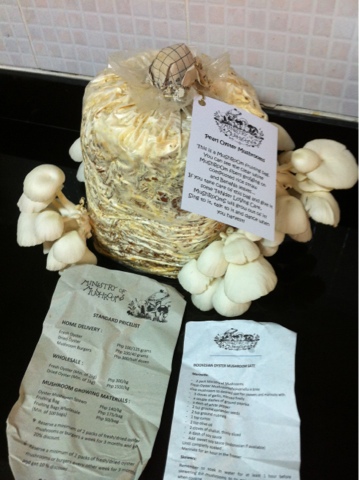
Got a fruiting bag of mushrooms to provide mycelium for a clone. The guys at the Ministry of Mushrooms at Saturday's Salcedo market are pretty awesome and helpful. I've now got a pot to sterilise my bulk substrate, some coir, some leaves, and I think I'm ready to go.

Friday, 11 May 2012

Treats for the Maggots


I hear Black Soldier Fly larvae like coffee grounds. My friends at the neighbourhood Starbucks obliged me with a metric assload of coffee grounds, some of which I intend to use in bulk substrate for growing mushrooms, some for my BSFL. The BSFL are quite active - today I found a couple on the roof of the bin and a couple on the walls. The reports I had heard from other tropical BSFL ranchers that they have incredible climbing abilities when the walls of the bin are wet appear to be substantiated. Now, to use that to my advantage in self-harvesting...

You can see the great, big, fat and happy larvae on my trowel there in the picture on the right. There is an incredible amount of size variance amongst the larvae, and these were easily 1cm long and perhaps 3mm-4mm wide. Many are still tiny. Just from observation, the fat ones are found in the vicinity of meat and the skinny ones seem to be found around vegetables, so I imagine the BSFL have sublimely fast metabolisms and their growth is only limited by the amount of protein they can find in their environment. I learn more every day.

In other news, the coconut guy came today to hack down some coconuts for us. I had one to celebrate. Deeeeee-licious. Of course, I saved the husk to dry for coir.

I gotta admit, I really have this wonderful sense of not knowing what the hell I'm doing, but truly enjoying just trying stuff out and seeing what works. The main thing is that I'm not throwing all this stuff in the garbage. It will go back into the land, somehow.