[part 1 here]
For a while, I had intended to write this post all by myself and make it a masterpiece of bloggery, so I started looking around for inspiration and links.
And I found others have already mastered this topic.
So I'm not going to write an article, post, diatribe, or paean: I'm going to stop right here and link to others' works that cover the topic far more thoroughly than I could in a single article. The overriding thesis: we don't need to do anything particularly organised to overturn the current economic order. All we need to do is reduce our overall need for money. That can be done through sharing, gifting, cooperation, crafting, making, and swapping - all of which is fun and builds community, which is far more useful than money. But don't take my word for it:
The concept of Earthship Village Ecologies links ecological concepts by creating work and resource flows rather than currency flows, and creating community instead of economy.
This is a good core article on the economic underpinnings of the Sharing Economy, and how we can resuscitate it for the modern age.
The Creative Commons is a global open-source style movement that gives a legal basis for sharing IP without giving corporations or individuals the opportunity to monetise or acquire the rights to an idea, product, or piece of work. A good example is this website for the sharing of free designs for 3d printing, in this case featuring designs for how to print an entire flying quadcopter. It's quite simply a fact that IP stifles small-scale economic development and in many cases is counterproductive. The people who realise this can share their concepts and code through these above movements so that their ideas serve the greater good of the community and allow small-scale economic development to expand.
The anti-colonial and anti-enclosure movement rising in (primarily) the third world seeks to defend cultural legacy from corporate patents.
The Transition Towns movement seeks to create regional and local economic autonomy and development from the "great powering down" that is starting now. The link is a practical primer on how to get local research to assist in economic development on a local level.
This is just the tip of the iceberg, but countless groups are looking at a less cash-intensive future that is more community-based, sustainable, and happy. Less money can mean less security in these cash-intensive times, but less need for money means greater security, more community, and in the end, more happiness for all concerned (except the bankers, who might actually have to learn to work for a living).
Showing posts with label New Economy. Show all posts
Showing posts with label New Economy. Show all posts
Tuesday, 2 July 2013


Tuesday, 9 April 2013
Subverting the Global Economy through Local Action, Part 1
It's a common and nonetheless sad story that, no matter where or who we are, we assume that the only way to change our lot in life is to rally behind a figure who, inevitably, betrays his or her ideals once in a position of power. The politicians who win elections can bend but won't act, and those who won't bend and would act: don't win. Leaders are, on the whole, incapable of NOT doing what the system is set up to make them do. In a democracy, politicians appeal to their base with stirring rhetoric to get elected, and once in power, must compromise and please the majority. That's the democratic system. On the other hand, authoritarian concentration of power comes greater need to offer power and wealth to the people who support you, and no matter how benevolent the despot, his innate sense of entitlement and ability to rationalise make it impossible for him to resist the trappings of power and reject its substance. So much for leaders.
We need a way for economic proverbial Davids to compete against proverbial economic Goliaths. The purpose is not to abolish the WTO, throw out the multinationals, eat the rich, and establish a dictatorship of the unions. That can't be done, especially not through any kind of direct conflict. No, the purpose is to make the people in your immediate area able to compete against money. Not simply against this company or that company, or this product or that product, but against the fundamental underpinnings of the entire neoliberal economy: money itself.
More in the next instalment. Read this for a taste of the direction we're going. A shout out to The Valhalla Movement, a step in the right direction.
So what have we got to rely on? First, we must take power over ourselves. Power over oneself is the greatest of powers, but we just happened to have become acculturated to giving this power up to authority to the point that we don’t know that it’s gone. Next, realise that there’s a lot more in this society than just governments and individuals. We're not only talking about ourselves, but the communities that we left behind to inhabit our soulless suburbia. Building on a few of my previous articles, I wanted to talk about how to use your personal power to make the world a better place. No, this isn't intended to be some kind of self-help or inspirational article. This is a blueprint for a peaceful and insidious revolution that just happens to be inspiring.
The global economy has made many goods very affordable. The more globalised we become, the cheaper everyday items seem to get. Economies of scale, container ships, and big box stores are efficient: they are able to produce the most amount of widgets for the lowest price. Efficiency is exactly what the global economy is about. Companies can move production of widgets to the countries with the lowest-cost workforce, countries that provide the most favourable tax laws, or countries that subsidise corporate inputs. Given the smorgasbord of potential options for cost externalisation (fancy language for how corporations make other people pay for the stuff they use) and arbitrage (fancy talk for simultaneously exploiting the margin in price between two regions for profit), companies can naturally make their homes in locations that offer them lowest cost for their operations.
The problem with this efficiency is that it means one thing: concentration. Profits become concentrated when corporations operate in an environment where they are free to reduce or externalise their costs. As much as I believe in the free market, I believe that everything from lower salaries and cheap electricity to favourable tax legislation and undervalued currencies are externalities naturally produced by the current way of doing business. My definition of a truly free market is as free of these corporate advantages as it is free of hindrances. All externalities must be internalised to create a truly free market. Economies work best when all actors have an even playing field. When the field is uneven, groups can effectively arbitrage (for example) the high-currency consumer power of country A with the low currency and tiny salaries of country B. There are plenty of multinationals that would be unable to survive if it wasn't for these arbitrages and externalities. In my opinion, they shouldn't survive: they are poster-children for unfair business practices and unsustainability... but I also understand that, when the only goal of a corporation is to expand share value, they will naturally act amorally to achieve these ends.
The WTO (formerly GATT) has facilitated a kind of corporate wonderland where corporations (through their governmental proxies) can take countries to court for throwing up trade barriers. Trade barriers, in this case, can mean even something as simple as health legislation (where the US forced the EU to accept hormone-laden beef that has been linked with increased risk for cancer) or environmental protection legislation (where Venezuela forced the US to allow them - effectively - to sell more polluted gasoline on the US market than extant EPA legislation allowed), or indeed human rights legislation (where Massachusetts was forced to deal with Myanmar even though they had made legislation that disallowed them to deal directly with despotic regimes). This is simply in their nature: corporations act to increase share value. They will use all tools at their disposal to grow, and prying open other markets is one of the things necessary for growth past a certain point. It is no surprise that GATT became the WTO and the WTO may likely expand to the TPP. It's a natural evolution. Predictable, really.
The problem with this efficiency is that it means one thing: concentration. Profits become concentrated when corporations operate in an environment where they are free to reduce or externalise their costs. As much as I believe in the free market, I believe that everything from lower salaries and cheap electricity to favourable tax legislation and undervalued currencies are externalities naturally produced by the current way of doing business. My definition of a truly free market is as free of these corporate advantages as it is free of hindrances. All externalities must be internalised to create a truly free market. Economies work best when all actors have an even playing field. When the field is uneven, groups can effectively arbitrage (for example) the high-currency consumer power of country A with the low currency and tiny salaries of country B. There are plenty of multinationals that would be unable to survive if it wasn't for these arbitrages and externalities. In my opinion, they shouldn't survive: they are poster-children for unfair business practices and unsustainability... but I also understand that, when the only goal of a corporation is to expand share value, they will naturally act amorally to achieve these ends.
The WTO (formerly GATT) has facilitated a kind of corporate wonderland where corporations (through their governmental proxies) can take countries to court for throwing up trade barriers. Trade barriers, in this case, can mean even something as simple as health legislation (where the US forced the EU to accept hormone-laden beef that has been linked with increased risk for cancer) or environmental protection legislation (where Venezuela forced the US to allow them - effectively - to sell more polluted gasoline on the US market than extant EPA legislation allowed), or indeed human rights legislation (where Massachusetts was forced to deal with Myanmar even though they had made legislation that disallowed them to deal directly with despotic regimes). This is simply in their nature: corporations act to increase share value. They will use all tools at their disposal to grow, and prying open other markets is one of the things necessary for growth past a certain point. It is no surprise that GATT became the WTO and the WTO may likely expand to the TPP. It's a natural evolution. Predictable, really.
We need a way for economic proverbial Davids to compete against proverbial economic Goliaths. The purpose is not to abolish the WTO, throw out the multinationals, eat the rich, and establish a dictatorship of the unions. That can't be done, especially not through any kind of direct conflict. No, the purpose is to make the people in your immediate area able to compete against money. Not simply against this company or that company, or this product or that product, but against the fundamental underpinnings of the entire neoliberal economy: money itself.
More in the next instalment. Read this for a taste of the direction we're going. A shout out to The Valhalla Movement, a step in the right direction.
Wednesday, 22 February 2012
Economy, Democracy, Climate Change
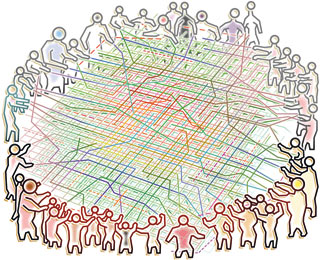
A short link to a very long - but very wise - dissertation on how to shift the economy to become more fair, inclusive, and democratic: by Benjamin Barber.
"As we’ve seen, capitalism can serve the green economy by being entrepreneurial in an inventive way and finding alternatives that will eventually make money for some people, as it should. If I’m right in what I’ve been saying, then it is our task first and foremost to restore democracy: the commonwealth, the public good, and citizenship. I’m suggesting that what’s wrong in the debate about greening and climate change is that we’re trying to meet the challenge of sustainability exclusively as consumers in a market economy; we’re acting in a way that doesn’t allow democracy to oversee the public good anymore. Science makes powerful arguments, but science doesn’t vote. What we need instead is a restoration of the role of the citizen, of public thinking, of the commonwealth, and of the public good. A green America is part of the commonwealth, not of private wealth or corporate wealth or shareholder wealth. Shareholders have their place too, but we mustn’t support private wealth at the cost of public wealth. We need advocates for the commonwealth, and yes, we have them—they’re called citizens. If citizens take themselves seriously, then they vote for politicians who uphold the public good. If we have only consumers involved in politics, then of course they vote for the people who uphold private interests and the lobbyists who represent them."
Tuesday, 21 February 2012
It's like Capitalism... except that it's Fair!

The next ten years are the prelimaries for our species' final exams, in which we discover whether this bold evolutionary experiment of combining a large forebrain with opposable thumbs was really a good idea. Practically, that means: can we get our act together enough to do what we know how to do to solve our environmental problems or, better still, eliminate and avoid those problems, not at a cost but at a profit, in a way that is trans-ideological, attractive to everybody, and with no, or hardly any, losers?
Economics is a topic far and cheap to my heart. This is because traditional economics only sees the environment as a source of raw material, and therefore as a part of the greater economy. As my heavily German-accented TA from one of my graduate seminars in international relations put it: "[economists] worship a false God". From a guy who started out his academic career in Economics, that's something of a grand condemnation. Our current economic trajectory is set by an economics of endless growth:
"The current system is broken," says Bob Watson, the UK’s chief scientific advisor on environmental issues and a winner of the prestigious Blue Planet prize in 2010. "It is driving humanity to a future that is 3-5°C warmer than our species has ever known, and is eliminating the ecology that we depend on for our health, wealth and senses of self." (emphasis mine)Economics itself is, at best, a pseudoscience. It is a dark art that attempts to explain complex, multidimensional, and cyclic behaviour through simple, monovariable, and linear means. It is better explained as part of the ecology rather than with the ecology as part of the economy. The problem is that many people conflate the word economy with money, or Capitalism - as if all economies since the Cold War are Capitalistic. Money economies have the problem that they tend to need to grow in order to survive, and that infinite growth has an inevitable run-in with a finite planet.
Capitalism today abuses the people, environment, politics and culture in equal measures. It has fostered new extremes of wealth and poverty inside most countries, and such extremes always undermine or prevent democratic politics. Capitalist production for profit likewise endangers us by its global warming, widening pollution, and looming energy crisis. And now capitalism’s recurrent instability (what others call the “business cycle”) has plunged the world into the second massive global economic crisis in the last 75 years. Manifesto for Economic Democracy and Ecological SanityEconomies are not all money-based, and it has taken a huge economic downturn - that is to say, a gigantic failure of Capitalism to do its job and spread the wealth equitably - to bring alternative economies to the fore. The Occupy Gift Economy is a prime example of the genre, but there are others. In Greece, for example, alternative economies are emerging to free the people from the yoke that money imposes. Such debrouillard economies - Systeme D - are growing like an economic superpower across the world. Their adherents know - just like your mechanic knows - barter is nigh impossible to tax. They also know that the purpose of the economy is not to amass the most green pieces of paper, it's to redistribute wealth. Accumulation is about the ego, redistribution is about the community. It's hard going in Greece, but they have been given an opportunity to show the world that the birthplace of Democracy - a force far more important than cash - can democratise economics, too.
Ironically it is in the gaps of a broken system that the shoots of a different, new economy get a chance to grow. ... But while disaster reveals a society’s economic and social weaknesses, it also reveals where true resilience and real value can be found - in the ability of people to cooperate at the local level to meet a community’s needs.The change into a local economy, based on barter and a local - informally issued - currency, can actually serve to revitalise the economy without need of money. Europe, especially Germany, has been experimenting with local currencies for years now. They are complete fiction, just like any other currency, but they get buy-in because they can be spent locally. Local merchants make excellent first adopters because they realise no big-box store would ever accept such stuff. In Canada, we have the brilliant idea of Canadian Tire Money, which some local bars even accept on the occasional special promotion night. Canadian Tire knows that Canadian Tire Money keeps people coming back. Parts of Greece are now using the Local Alternative Unit to purchase goods. Does money have to be centrally issued? No. In Canada, you can settle a debt for goosefeathers if both parties agree. You can't pay taxes with them, but contract laws allow you to barter anything for anything, so long as both parties agree to the transaction.
People are even considering new ways of making business equitable. Co-ops are growing in popularity. There is a plethora of startup information online for creating co-ops, and analyses of how a cooperative economic system might develop.Other systems exist, such as a "Circular Economy" based on recycling; Holonic credit networks that are holographic groups of groups of groups that trust one another and are willing to extend one another credit based on their relationships; and Sharing Economies much like the gift economy discussed above. These are all viable ideas that fly in the face of the monetized "everything has a dollar value" paradigm.
Economies that run on money work, but they don't work equitably. Certainly they drive all sorts of interesting social and industrial forces... but I'd rather be assured by my economy that I can eat than be assured by my economy that I can keep my teeth white and hair tangle-free. The goal of an economy is to redistribute wealth fairly. A even a free market can distribute wealth fairly - if we construct it with that aim in mind.
Wednesday, 3 August 2011
New Economy
An article in The Nation that covers some of the issues we should be wrestling with...
Most of the projects, ideas and research efforts have gained traction slowly and with little notice. But in the wake of the financial crisis, they have proliferated and earned a surprising amount of support—and not only among the usual suspects on the left. As the threat of a global climate crisis grows increasingly dire and the nation sinks deeper into an economic slump for which conventional wisdom offers no adequate remedies, more and more Americans are coming to realize that it is time to begin defining, demanding and organizing to build a new-economy movement.
Subscribe to:
Posts (Atom)