Sustainability and good governance... with a little bit of bioremediation mixed in.
The Green Gap
Wednesday, 8 February 2012
Who Will Save the World?
1. MAKERS
Who might fit in this group: people who like to tinker, who are good with their hands, prefer doing to talking, like to show not tell, and love the smell of freshly extruded thermoplastic.
Whether you're in one of the several groups currently working on open-source fabrication technology, a subscriber to the magazine MAKE, or determined to be able to build your own techno-farm, you might fall into the Maker camp. These are the people democratising technology and making building fun (and cool) again.
Why I think they're important: because you should know how to "prototype early, and prototype often". I remember reading about an experiment where groups of people were asked to build a simple structure out of straws. Kids typically performed better than MBAs and very close to CEOs. Why? They get in and tinker right off the bat. They try. They don't sit there planning for half the allotted time they get out and do something. That spark of intrepid and adventurous inventiveness is fanned to a flame in the Maker movement, and we're going to need that creativity and impetuous embrace of mechanical challenge to solve the problems that are coming at us now.
2. PERMACULTURISTS
Who might fit in this group: people who like design-intensive (but less work-intensive) activities. People who like to be out-of-doors, who love thinking about how plants work together in an ecology rather than how to plant your tomatoes in a nice, neat row. People who want to tend a forest of diverse species and be inclusive of all the services the ecosystem provides, from the trees and shrubs to the insects and animals. If you prefer to be a steward of your garden and not a slaver, you're likely on the path to Permaculture.
Why I think they're important: because they are the antithesis of taming Nature and bringing Her to man - they take man to Nature, and meet Her half-way.
3. OPEN-SOURCERS
Who might fit in this group: anyone who feels that design should serve the whole of society and not benefit a corporation. People who understand that patents don't encourage invention, they actively throttle it. People who have used and benefited from wikipedia, firefox, linux, or any number of other free services provided by the open source movement for the good of all.
Why I think they're important: Open-source is living, breathing proof that not only can collaboration exist without remuneration, it can compete with corporate design and development. Partisans of the old economy would prefer to think that money is the only thing that can give an object or effort value, but open-source kicks sand in that idea's face. The fact is that informal economies - economies not based on money transactions - are eminently possible and even desirable when compared against the alternative. Open source isn't simply a greater way to innovate, it's proof positive that money isn't everything.
4. TRANSITIONISTAS/SUSTAINABILITY Crew
Who might fit in this group: you read The End of Growth (or perhaps just a short article about it), or understand the realities behind Hubbert's Peak, or perhaps read that the armies of the United States and Germany are both basing their long-term strategic planning on resource scarcity. You want to do something about this scarcity, and you want to take your whole town with you into a post-scarcity world with a resilient and renewable local economy. Welcome to the transition movement!
Why I think they're important: These guys are action-oriented and collaborative. They advocate, involve, build consensus, and motivate. Instead of whining about the state of a local economy, they actively promote economic improvement of a town based on locally-available renewable resources. They focus on down-to-earth value-building proposals and real job creation - not efficiency. This is the exact opposite of the soup-kitchen Depression mentality. Transitionistas make their own damn soup, or buy it locally with the town's own currency. Sustainability dudes have got their soups planned for the next 25 years.
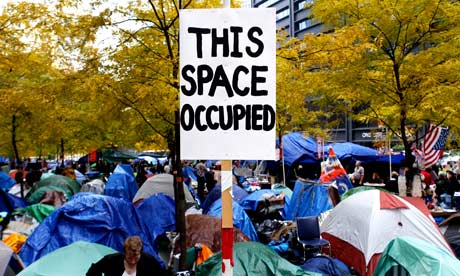
5. OCCUPIERS
Who might fit in this group: 99% of all people, and anyone else who gives a damn. You'll notice there are no links in this section, I recommend you simply write "occupy" in your favourite search engine and follow the rabbit hole.
Why I think they're important: Quite frankly, because most people still don't understand that we're participating in a system that is exploitative by nature. Occupiers are the educators of the age, the people who understand that the global economy is built to create concentrations of wealth, not distribution of wealth. The concerns and issues raised by the Occupiers are many, but perhaps this one phrase encapsulates most of them: banks may be able to create money, but they sure as hell don't create value. Only people can do that.
6. SYSTEMS THINKERS
Who might fit in this group: people who look at the decisions other people make, and realise that almost nobody takes the consequences of their actions into account when they make those decisions. Systems thinkers are a rare new breed of human that perceives things in cycles and flows rather than linear processes of cause and effect. People who would like their idea to last generations, not years.
Why I think they're important: We can't keep thinking of the universe in the old terms of make, eat, poop; extract, consume, dispose; or creation, judgement, rapture. This is a world where actions have consequences - and consequences have consequences. Using systems theory, we can build systems that can sustain themselves based on the intelligence of their own design. The world is not a place inhabited by cause and effect, it is a place ruled by incalculable interoperating systems, where cause and effect are difficult to calculate. Systems thinkers get it.
7. GREEN ECONOMISTS
Who might fit in this group: people who understand that the market isn't truly free. Economy is a subset of ecology, not the other way around. People who see that subsidies are simply externalities paid for by the taxpayer; that when a government gives preferential treatment, they make an economy weaker. People who know that the doing the right thing by the environment should - due simply to the laws of physics - be the right thing to do economically, as well. In short, you believe that profit and environmental stewardship are not only not mutually exclusive, they're practically intertwined.
Why I think they're important: Green economics is the great Capitalist hope for the coming economy. The belief that the market can - with an even playing field - do right by the planet. If you read Amory Lovins and anything from the Rocky Mountain Institute, you'll understand just how infuriatingly simple it would be to make an economy that not only creates jobs but protects the environment.
8. BIOMIMICS and BIONEERS
Who might fit in this group: people who realise that the energy buck stops with the sun; who see that incredible non-polluting chemical processes occur at room temperature throughout the world; who understand that nature has a 4-billion year head start on us for trying out the solutions to things, well, you might be a biomimic. Perhaps you've been inspired by John Todd's Living Machines or follow the work of Ocean Arks International. One way or another, you've been inspired by great thinkers who prefer to learn from Nature than enslave her. She's already solved these problems... why reinvent the wheel?
Why I think they're important: I'm a lazy guy, really. The less work I do, the better. I also like stuff that's closed-loop and easy to manage, and pays for itself after an initial investment. That's a good deal better than sewage systems that pollute. Why can't we have sewage systems that heal, instead? Why can't we simply listen to Mother Nature, and do stuff smarter, cheaper, and cleaner?
9. TRADITIONAL and INDIGENOUS PEOPLES
Who might fit in this group: well, it's rather obvious from the title... but people who learn from, study, and aid their local Indigenous Peoples groups are all part of this network.
Why I think they are important: well, there is a reason we call them First Nations peoples. They were around before us, and learned to live at peace with the land before anyone thought to take it away from them. Now, after all these years of neglect,we realise too late that the knowledge that colonising powers have sought to eradicate is exactly the knowledge we need to aid us in our survival in the coming generations. We are realising our folly at having destroyed so much of the treasure trove of indigenous wisdom. Thanks to the efforts of indigenous groups, that knowledge is being preserved, recovered, and revitalised. I'm in no position to speak for the First Peoples, but I am in a position to say this: we need to be quiet and start listening rather than speaking. We've a lot to learn, and there's not much time.
That's just a few, and I know I've missed many, so I encourage you to add more in comments. We've a lot of work to do, but the work as already started. It's not a matter of where to start - it's a matter of picking who you want to help.
Saturday, 24 December 2011
Revisiting London
I wrote this article around the time of the London riots when everyone was still pretty sure it was just a bunch of young hooligans taking to the streets to steal stuff. The Economist has since blogged about this feature in the Guardian about the London rioters that has clearly been tempered by the new and growing understanding of the Occupy Movement. Even the Archbishop of Cantebury has gotten into the act.
The Archbishop says:
But when the endemic problems they identified are combined with the impact of massive massive economic hopelessness and the prospect of record levels of youth unemployment, it isn't surprising if we see volatile, chaotic and rootless young people letting off their frustration in the kind of destructive frenzy we witnessed in August.Prior to which, I had said:
Do these protests seek the overthrow of governments? Do they seek democracy and accountability? Perhaps. The immediate need that is being fulfilled for most people in these protests isn’t democracy though. Democracy isn’t a need. Accountability isn’t a need. Hope, however, is.Who would have thought an Anglican Archbishop and a Pagan Greener could have so much in common?
But this isn't a chance for me to say "I told you so". I'm here to talk about something I didn't expect - and perhaps should have, given our knowledge of how the Spring started. It's the role of the police, and the exercise of power in general, that was a major driver in this riot:
Economic issues were important. The cause most often cited for the riots was poverty (86%), but unemployment (79%) and inequality (70%) featured prominently too. Few guessed, though, that this tinder in the box was lit at least as much by the long arm of the law as the invisible hand of the market. Almost three-quarters of interviewees said they had been stopped and searched by the police in the last year; 85% said "policing" was an important or very important cause of the riots. Just 7% believed the police do a good job in their area. (Younge, Guardian)We have been seeing it over and over again in Occupy protests: the police are perceived as the enforcers of the 1%. Let's not consider that fact, let' take the angle of critical theory and simply analyse that statement as a text. Why are so many people in ostensibly free democracies stating that the police are the tools of the elites? Why would a major cause for the London Riots be the invasive and repetitive imposition of police authority on the working classes? The reason in Tunisia, Egypt, Syria, and Libya is clear... but could it be that there has been a general perception of an erosion of personal rights even in the "Western Democracies"?
I'd say that's a pretty safe bet.
And when you hear people like screenwriter Patrick Meighan (The Family Guy) write:
I unlinked my arms voluntarily and informed the LAPD officers that I would go peacefully and cooperatively. I stood as instructed, and then I had my arms wrenched behind my back, and an officer hyperextended my wrists into my inner arms. It was super violent, it hurt really really bad, and he was doing it on purpose. When I involuntarily recoiled from the pain, the LAPD officer threw me face-first to the pavement. He had my hands behind my back, so I landed right on my face. The officer dropped with his knee on my back and ground my face into the pavement. It really, really hurt and my face started bleeding and I was very scared. I begged for mercy and I promised that I was honestly not resisting and would not resist.And when you hear about people like Retired NY Supreme Court Judge Judge Karen Smith:
My hands were then zipcuffed very tightly behind my back, where they turned blue. I am now suffering nerve damage in my right thumb and palm.
Karen Smith was working as a legal observer when she saw a distressed woman pushed to the ground and beaten by an officer, she said.
When she demanded he stopped, the unidentified cop pushed her against a wall and threatened her with arrest.
Luckily, now, the lawyers are coming out. No, I didn't think I'd ever hear myself say that... but bear with me. Police actions have not ceased in their ferocity, I only just today saw several tweets regarding citizen journalist Spencer Mills (@Oakfosho) getting clubbed by a baton today (23.12.2011). Encampments have been destroyed, but something new is coming out of the movement: dissipation has brought new approaches.
The police can fight pitched battles in open squares against hundreds of unarmed protesters. That's something riot squads are trained for. But can they stop the hydra they have created by chasing the protesters from the squares? No. They have simply forced the occupation to adopt more effective tactics in pursuit of the same general strategy.
In this, as in so many events in history, I see one of those glaring "you really should have negotiated at the start" moments. The soft way could have aided the authorities, but they used the hard way, and fanned a spark into a flame.
Tuesday, 13 December 2011
The End of Wishing
I speak for more than half the world’s population, we are the silent majority. You’ve given us a seat in this hall, but our interests are not at the table. What does it take to get a stake in this game? Lobbyists? Corporate influence? Money? ... You have been negotiating all of my life. In that time, you’ve failed to meet pledges, you’ve missed targets, and you’ve broken promises.She's right. Hell, I'm more than twice her age and they've been negotiating MY whole life. As a youth, I wrote a letter to then Prime Minister Brian Mulroney about Acid Rain - he's the only Prime Minister who actually wrote me back and signed his name on the paper, by the way. Now, after Canada took so many strides to stop the tide of noxious chemical fumes across the border (admittedly, the noxious fumes mainly stopped due to American government regulations that stated industries had to openly declare their effluents, combined with the fact the bottom fell our of American manufacturing), and was viewed as a leader in Environmentalism by so many, we've stepped out of Kyoto. Durban has been the final confirmation of a sad fact: national governments are both unequipped to and incapable of effecting adequate change to save our children's future.
At first, the thought is immensely depressing. We wonder why we let ourselves get strung along for decades with nothing but unfulfilled targets as our recompense. We wonder how - after cultivating such a careful cynicism - we could have been duped. Depression turns to horror as we think of the world our children will inherit. Horror at the thought that our kids will have it even rougher than us. Our generation is the first generation in recent history that will have less than the generation before it. Where we are newcomers to (or soon-to-be newcomers to) an economy where the search for jobs is cruel and unrelenting for so many... will our children enter a world when their search is for fresh water? Arable land? We have wants, but what wants will they have?
If you take a moment, though, it is possible to transcend this horror. We can break through the veil of inevitability if we simply change the way we look at the situation. If governments keep getting made by promises that aren't kept; if we sense that there is a rule here that seems to govern governments such that they inevitably end up taking the most wildly shortsighted path toward the future; if we are seeing the same thing happening over and over and over again, we might just be stuck in a self-perpetuating and self-reinforcing system. Knowing that is the first step to liberation. It doesn't sound like it, but bear with me.
There is an ancient Norwegian poem that has a stanza which states, "Ice we call the broad bridge (Ís kǫllum brú bræiða)". If you think of it, a seafaring people which used rivers for trade shouldn't think of ice that way. Rivers were the conduit to their sources of wealth inland, ice was a stopper of commerce and... well, let's be honest... raping an pillaging. There can't be anything good about a drakkar frozen into the ice if you're a Viking. If you think about it, though, the stanza makes sense. Ice allows you to cross to the other side on foot. Previously impossible communication and trade is now possible. It just so happens that you have to use a different mode of transport, and the direction you're travelling is perpendicular to the direction you would normally travel. It takes a change of outlook, but the change doesn't mean the end - it just means you've got different opportunities.
As long as you can wrap your head around the change in lifestyle, you're gold.
The first step is realising there's a problem. The drakkar's frozen in the ice, and you're not going downriver anytime soon. Governments are trapped in a positive feedback loop that makes them do things that are not in their own long-term self-interest. In this case, it makes no sense to down the oars and grab the rudder. You're not going anywhere that way. You have to acknowledge the predicament you're in, and have a good think.
A good first stop to learning how to change a system is Donella Meadows' masterpiece article "Leverage Points: Places to Intervene in a System". Donella Meadows is an unsung genius of systems theory, and sadly, she was lost to us before her time. What remains of her written work is well worth a read as she had a knack for making the unfathomable into something not only understandable but palatable as well. An easy reference to the twelve leverage points is on Wikipedia and her book, Thinking in systems : a primer, is available on Amazon. Her advice is great, but perhaps not exactly what we need right at the beginning. What we need at the beginning is a less sweeping philosophy. We need something a little more local.
If the national government is unable to change, then focus smaller. Change can happen at the Provincial level, the Municipal level, even the community level... but it can also happen on the individual level. As long as we have some objectives in mind when we do our local thing, we are acting in the interest of the "think global, act local" mantra. One global change we can enact locally is to rely less on hard currency, and save it for what we can't avoid using it on. If you do one or two things that either help you not spend money, or help you trade goods rather than services with other people, then you can hold on to cash for things like the heating bill - which can't be paid in carrots. Here are a few general ideas to start us down that road.
Money is a golden treadmill. The more comes in, the faster you run, the harder it is to get off. Debt is the same, only backwards. Either way, you're running... and the more you run, the more the wheel has you. The key is not to have more money or simply reduce your debts. The key is to reduce the need for money in you life. That can happen in a number of ways, and the most important one, in my opinion, is sharing. Our economies began in gift-giving and social debt rather than barter and financial debt. The concept of debt was originally moral rather than accountable. Many societies continue this gift-giving tradition. The Japanese, for one, give gifts all the time - though if you ask them, they'd like the whole tradition to stop. To my friends and family in Japan, gift-giving is a bit like a treadmill, too - once one gift is given, you MUST reciprocate. It can go on forever, and this problem is compounded by the fact that the gifts are typically useless and purchased with money. What's more, when I take a gift to my friends or family in Japan, it's typically food and they typically feel obliged to open it right there and share it with you, which is kind of defeating the purpose of giving them something. I love the Japanese very much, but their culture, much like every other culture in the world (mine included) has its weird parts. My father-in-law has a solution. He grows organic vegetables. His vegetables are DELICIOUS. He tells me with great relish how he brews up garlic and hot pepper sprays as insect deterrence, cuts bottles into little whirlygigs to put on poles so the ground vibrations scare moles, and he also likes to discuss the finer points of keeping a matsutake mushroom plot secret. To this day he's still opaque about whether or not he ACTUALLY has a matsutake mushroom plot. Well played, dad-in-law, well-played.
His goal, however, is the farming itself... so he doesn't keep most of his harvest. His vegetables go straight to his clients, who are quite delighted to have them. Here's the solution: give something home made and useful, like vegetables. Make wine or beer. Have an apple tree in the front yard and share the fruit. Do something cheap (or preferably free), make a surplus, and give it away. If it is something that replaces money that someone else might have spent, you've done your job. You have successfully stopped money - even if it's pennies - from entering the market. Gift-giving can turn into more long-term and regular arrangements. For instance, I currently teach English to a person who, in turn, comes to my house and teaches my son Japanese (and gets a good lunch out of the bargain, as well). Give what you have to show what you've got, and perhaps someone else will make the deal more permanent.
Have you spoken to your neighbours lately? Do they have a car? Do you work in the same place? You could commute together. Cars are the bane of my existence. They are endless money pits that do nothing but depreciate in value, pollute the air, and break down unexpectedly. When I was living in Canada, I walked to work 45 minutes every day (yes, even on THOSE days). I still had a car for groceries and the like, but I walked to work. It's something you might want to consider: if you have a car, you may be wasting money. Here is a nifty calculator to determine how much that might be. Here's a quick tip - buying a new car is about equal to adding over $100k to your mortgage. Ask yourself, would you like $100,000 more house, or would you like a car? If you feel you need a car for your job, is it a job you really want to be doing? Could you do a job within walking distance for $500 less per month instead of paying for insurance and gas and lease and repairs? Currently, I live in a huge metropolis with horrible traffic, and I ride a little electric scooter. It's slow, it's small, and it's cheap... but it also fits between the cars, and I get home faster than anyone driving in a four-wheeled vehicle. You could get a similar model - or an e-bike - for a reasonable amount. As a matter of fact, it's about the same as a standard adult-sized bike. To me, I'd rather pay higher rent and walk/bike than pay rent and be a slave to a car lease. In the end, not owning a car is a good financial decision, and by doing so, the money treadmill turns slower.
Going back to a gift-giving and barter economy (at least in small part) should assist us save a little money for lifestyle improvements down the road... like that solar panel you always wanted, or just a better mash tun for your all-grain brewing operation. Those are a few ideas that you can use to wean yourself and your friends and neighbours off hard currency a little. Trust me, these skills and flows of goods will come in useful! If the power goes out for a couple days, you'll be glad to know that Maggie down the road has fresh veggies, that Jim on the corner has the compost Maggie likes, and you've got the homebrew that Jim likes. These little safety nets make life a little more comfortable.
The next stop on this ride is municipal policy, and you can start to read about that here and here and here and here...
Tuesday, 11 October 2011
Revisiting the Open Letter to Mom and Dad
What we've learned now is that the economic crisis of the 1970s never really went away. It was fobbed off by cheap credit at home and massive plunder abroad – the latter, in the name of the "third world debt crisis". But the global south fought back. The "alter-globalisation movement", was in the end, successful: the IMF has been driven out of East Asia and Latin America, just as it is now being driven from the Middle East. As a result, the debt crisis has come home to Europe and North America, replete with the exact same approach: declare a financial crisis, appoint supposedly neutral technocrats to manage it, and then engage in an orgy of plunder in the name of "austerity".Echoed my own sentiments so closely that I was relieved to know at least one other person was thinking the same way as I: that this is the fight our parents failed to finish in the 70s. They failed to finish it because the oil taps opened up again, credit began to flow, and stagflation made them hold on to their jobs. It was a perfect storm of threats and inducements to maintain the established economic order.
Thankfully, people are standing up and calling a spade a spade. On the 6th of March this year, I said:
We're at a historical tipping point. There is still time to do something about it, but the job of my generation now is to force [your generation] to care. We've got to snap you out of this late-life reverie of a paradisiacal post-employment existence in the south of France, sipping wine. The economic system is buckling. If we keep thinking of things in the terms of well-worn economic adages (you know, the same theories that said such a thing as stagflation couldn't exist - the same stagflation you lived through?) we will keep getting the same economic results. We need a change. We need you to wake up that dormant war-resisting flower child. We need to pull the cobwebs off your sleeping inner homesteader. Didn't you notice that the American boomers - the ones who grew up as flower children - were the same parents who proudly sent their kids off to war in the Middle East?Well, here we are.
Monday, 26 September 2011
American Spring?
Globalrevolution Live Cam
Facebook Group: Occupy Wall Street
Note: if you type "Occupy" followed by a space in the search bar in Facebook, you'l be presented a list of "Occupy [cityname]" pages where these little movements are springing up. I think the last number I heard was 5000+ for the NYC group and rising. This is being unreported in current mainstream media. Please repost wherever you can.
Saturday, 27 August 2011
London Riots
Occasionally, the ideas of many become synchronistic enough to manifest a Zeitgeist. A meme catches on like a wildfire; unanimity builds out of formlessness. This often happens within, but not across, demographic boundaries. Each demographic may take similar actions, but for entirely different reasons. From these manifold motivations uniform actions can come, but more often than not, manifold motivations manifest manifold machinations. In order for a meme to jump demographic boundaries, it must affect either the importance of a motivation (e.g. hunger normally trumps jewellery) or the utility of an action (e.g. employment can fulfill several human needs, whereas food can only fulfill a few – and only one or two of those things isn’t naughty). Our human capacity to “muddle on through” seems to be based on these fundamentals. We know, without need for deep thought, that food is more important than most things in life, but when it is plentiful, we turn our eyes to the next most pressing motivation. A hierarchy of needs (though it is likely not Maslow’s) is there, but we conveniently forget necessities when they are fulfilled in order to concentrate on the next need that needs fulfilling. That is the truth of it: human activities are so seldom exactly uniform because we are all acting on a different set of immediate circumstances. We have different contexts and different immediate needs. Fulfilling long-term needs, especially when the immediate opportunity cost is high, is not in our programming. Unanimity is, therefore, tough to manifest.
Unanimity is further obscured due to the fact we are products of learned behaviour. To a perpetual student, the solution to the lack of jobs is more training. To a junkie, the solution to coming down is another hit. To a gambler, the solution to going bust is just one more roll of the dice. Stepping out of our programmed patterns of behaviour is difficult, and uniform action requires many people step out of their comfort zone. That’s hard for humans to do even in a nurturing and accepting environment. I’ve met very few people who take to new experiences well. For many, it takes at least a moment of reflection, but more often it takes deep thought, rationalisation, and time to let the new reality seep in. Few people adapt immediately to the loss of a job. Few people can adapt readily to the loss of a loved one. It takes time to get used to the idea that you’ve graduated from grade school. Change is tough, and takes some coping to get right.
Then came the Arab Spring. We in the West persist in calling it a rising up of people to fight for freedom… but freedom is such an ephemeral and hard-to-quantify need. As a matter of fact, it isn’t really a need at all. Except in Libya, which seems to be an odd anomaly, the popular uprisings have been peaceful. The repression has not. Still, in Syria, peaceful protests persist even in the face of slaughter. Do these protests seek the overthrow of governments? Do they seek democracy and accountability? Perhaps. The immediate need that is being fulfilled for most people in these protests isn’t democracy though. Democracy isn’t a need. Accountability isn’t a need. Hope, however, is.
While hope itself may seem ephemeral and hard to quantify, I assure you, hope is a Boolean variable. You either have it, or you don’t. Here’s how to tell whether you do: if you think that there is a possibility your life could be better tomorrow than it is today, then you have hope. The martyr who lit himself on fire and ignited the whole Maghreb had lost all hope. Upon reflection, it appears that hopelessness resonated throughout the region. Where the middle class is rapidly being put into its place as a new underclass beneath the hyper-rich and the despotic, the hope that hard work will result in a more comfortable and happier future is wearing off. Mobility was promised to those who could do their time in post-secondary education and stick it out in entry-level for a few years, but that security had become more and more tenuous. In all of the Arab Spring regimes, protest was not permitted. Protest of any kind was considered seditious. Peaceful protest in and of itself was and is therefore notable. That protest is now sending a message to leaders in the Maghreb and in the Middle East: give us a better future or get out of our way. The dimmer the light at the end of the tunnel appears, the more realistic it seems to dig a new tunnel.
Similar dynamics are at work closer to home. The Obama election campaign tapped into America’s lack of hope with an unrelenting zeal. His progress, once elected, was steadily watched. The electorate waited with bated breath for when he was going to work his miracle… but his presidency has been marked by simple, though reasonably sensible, governance. He can’t crack the lobbies, nor can he undo partisanship, nor can he wrench himself easily out of military commitments made during the preceding presidency. The weight of history is heavy on his shoulders, and his ability to create more hope in America than there was before his election has likely fallen short of expectations. Whether this will affect his re-election is a moot point; his election itself proved that there is the beginning of a unanimity of purpose that is spreading throughout America. It is proof positive that the idea of hope, necessitating change, is a meme that has jumped demographic boundaries. Hopelessness moved the swing vote. If the vote doesn’t provide results for hopelessness… then what will hopelessness do next? Is it lost on people in Europe and North America that the middle class is becoming a new underclass for the hyper-rich? The same hopelessness of being crushed under the boot-heel of a despotic regime is dawning on the middle classes of the developed world, but it is no despot who is doing the crushing. The hopelessness comes from the hedge funds that annihilated their retirement savings. The investment houses that set their retirement savings up to be annihilated. The government that allows the same criminals who perpetrated this travesty to get away, scott-free, with their bonuses intact. There is a new sense of hopelessness rising in the developed world, and more and more, western governments are using familiar methods of curbing it.
We can see an indication in the London riots as to what may happen. I had predicted the Arab Spring would come to Europe and the US, but I admit I had not predicted it would turn violent, nor did I think England would be the first to taste it. Writer after writer have fallen over themselves attempting to distance these looters and rioters from the nobility of the Arab Spring, but such distinction is rhetorical, self-congratulatory, and wrong. The rioting in London is equally produced by a confluence of hopelessness. The methods used are equally an affront to the establishment. Whereas in Egypt, massive protests were seditious even if peaceful, in a democracy, peaceful protest is just par for the course. It was when the powers that be stopped listening to protesters that protest itself gave no feeling of hope. The rioters in London have spoken in a language that is heard by Whitehall as loud as the voices of the Arab Spring have been heard in palaces around the Middle East. These were not race riots, they do not conform to readily identifiable trait except this: they are a different kind of uprising. Cracking down on them will only reinforce the sense of hopelessness they manifest. Pouring water on a flame will normally douse it.
That is, of course, if it wasn't started with oil.
Sunday, 1 May 2011
The Problem Is the Incentive Structure
Why aren't corporations aren't targeting the "Base of the Pyramid" (BoP), that 4-billion-strong cadre of low-income consumers?
I reckoned it could have been any number of things, but let me walk you though my first ideas.
1) Perhaps they just had an information gap. It's possible that with over 60,000 multinational corporations (MNCs) in the world, every single one of them has been utterly and completely kept in the dark regarding four of the six billion people on the planet. OK, maybe that's not very possible. Next idea.
2) Perhaps they had information about the BoP, but were subject to prejudice regarding their ability to be a market. I'm certain that a lot of this exists. People in business who think you can't sell something to someone who works for a dollar a day are more than likely the majority. Still, for there to be virtually zero interest in business to serve 4 billion willing customers, that prejudice had to be not only deep-rooted and persistent but pervasive. It means that even when a visionary leader has come along who thinks that serving the BoP could be good business, that prejudice has, until very recently, always won out in the end. I have a hard time believing that this is the case, not only because it requires "perfect prejudice" (and not everyone over the past 60 years has been thus) but also because that prejudice has been overcome by a select few companies. It's clear that there are people who want to sell to the BoP, it's just corporations don't allow them to do it. Next!
3) Perhaps they tried and failed to tap the market. Possible. Hart routinely stated in Capitalism at the Crossroads
4) Perhaps the corporate culture played a role. I'm going to be an armchair anthropologist and theorise that there are three things cultures do: stuff that they know is pragmatic and useful in their day-to-day lives, stuff that they know is sacred and useful to their spiritual lives, and stuff they know is taboo. Corporations are no different. Some examples: sales incentives are pragmatic (because they encourage a beneficial activity); staff retreats are spiritual (because nobody can prove they do anything useful, but people still believe in them); and presenting market data about the company in anything but the most glowingly positive terms in the quarterly report is simply taboo. Corporations try to minimise risk and maximise gain. It makes sense that the activities a company considers pragmatic, those activities that make up its culture, are things they've tried before that worked. Humans are innately conservative in this way, we tend not to like to step outside the bounds of stuff we've done before. It makes us uncomfortable. While there are people who really enjoy that kind of discomfort (me, for example), in a working environment where the culture is propagated by all your coworkers, it is hard to be innovative or step outside of your corporation's comfort zone. So far as I can determine, anything not pragmatic or spiritual is taboo when it comes to corporations. I'd go so far as to say that if the idea of serving the BoP somehow got past the first three ideas above, it would be stopped dead in its tracks at this one. Hart called this the corporate immune system, and it's a great analogy. Except in this case, the immune system is malfunctioning, like in Hashimoto's Thyroiditis or Crohn's Disease. The immune system attacks the good parts of you as opposed to keeping the baddies out.
All of these ideas get back to a central point: the incentive structure. Why? Well, perhaps there was an information gap, but why would such a thing happen? Business planning models rely to a degree on demography to pinpoint potential customers. Lamborghini doesn't think about me, because I will never have enough cash to purchase a Lamborghini. Equally so, most companies in the developed world have products that simply aren't a demographic fit for the BoP, more or less by design. This is because corporations attempt to create as big a market as possible with the highest margin possible by measuring potential demand versus total production (supply). Any and all traditional models that serve the BoP are likely considered high-volume low-cost because culturally we are accustomed to modelling the consumer as an individual rational actor who attempts to maximise value. We don't model individual phone service providers with access to microcredit, such as Grameenphone did. This cultural prejudice biases us against low-income purchasers because we misconstrue their actual purchasing power. If we modelled them any differently, we would run up against a corporate taboo: we would step outside the bounds of that which is corporately pragmatic or spiritual. There are always going to be actors in a corporation whose interests coincide with stamping out that which is neither corporately pragmatic or corporately spiritual, because the corporate system privileges the minimization of risk. The unknown is a risk. When you associate a risk with an ongoing expenditure, you will have executives - stumbling over themselves to look good to their shareholding puppeteers - to cut it.
So, all this to say that corporate culture incentivises the information gap because to use untested and unknown models to gauge projected profit margins is risky. Why gather information about a demographic it isn't profitable to sell to? Corporate culture incentivises prejudice because of this same reason - but it could equally be that a corporation has tried and failed to sell to the BoP and this engenders further prejudice. Corporations will try and fail to serve new demographics because of their inability to approach the demographic in a culturally sensitive way, instead considering the extant first world model to be sufficient, then wondering why it doesn't work. This is because, again, stepping outside standard operating procedure is considered an unnecessary risk even if it shoots the venture in the foot from the beginning. Finally, in corporate culture, the incentive is to minimise risk and maximise gain, and executives will a) always be coming in and out of the organisation, and b) always be on the lookout for ways to make their mark. One of the main ways to do so is to "trim the fat" and one day, eventually, your beloved BoP project is going to be that "fat". Your growth horizon is farther away than that executive's likely date of leaving the company. If you don't show spectacular growth in under 6 years (3 preferably), be very afraid.
If something doesn't work, and it doesn't work repeatedly, and it fails in the same way each time, there is a really good chance that the problem is systemic, and not just the victim of the whims of fate. Successes in reaching the BoP are certainly successes against the odds. As I mentioned in my previous blog post, a startup is more capable of navigating the rough waters of a BoP strategy because it comes without as much baggage.
The solution here is not to plead with corporations to do the right thing. The solution is to build a smarter corporate model from the ground up.
More on Capitalism and Profit
"...it is precisely the incumbents that most often stand in the way of fundamental change."
(paraphrased from Saving Capitalism from the Capitalists
"It's been said that capitalism is like a knife: It [sic] can be used to cut off your brother's arm, or it can be used to butter bread and feed the hungry - the same knife."
While I think that the simple line "capitalism is a double-edged sword" would have been fine here... we get the idea anyhow. We're back to my contention that capitalism is a force, not an idea or a method or a practice... it's just a fact. Funny how people just don't come out and say that. Capitalism just is. Any business practice that does not incorporate capitalism in its raw form is just an incorrect assumption regarding a potent force of nature, and is therefore dangerous. You should not look at a tornado and call it cupcakes. That's both wrong and potentially harmful to you and any easily manipulated cupcake lovers nearby.
Hart continues: "The problem with capitalism is thus not the profit motive; the problem is how the profit motive is conceptualized. ...there is a persistent myth that the ultimate purpose of business is to maximise profit for the investors. However, the maximization of profit is not a purpose; instead, it is an outcome. The best way to maximize profits over the long term is not to make them the primary goal."
In this statement it is like he is tantalisingly close to a breakthrough in understanding that profit and share value are two separate and distinct animals that don't often have much to do with one another. If Hart could see that the system has incorrect feedbacks at the level of the organisation of the corporation, he might be closer to understanding why certain BoP pilots he used to formulate his BoP Protocol failed. Briefly, the reason why they failed is simple: the quarterly report.
Why? From a systems standpoint consider the following:
1) Sustainability requires the ability to see long-term advantages.
2) The quarterly report comes out every three months.
3) A day trader clears his portfolio every night. How many investors buy big in one company and go long?
Stock price movement and the long-term success of a BoP approach are, simply through their incongruous rhythm, thoroughly disconnected. Every quarter for a long period, the only thing an investor is going to see of the BoP initiative is an unnecessary expenditure. Certainly, there are astute investors who think five years into the future, but they aren't thinking about your company five years into the future - they are thinking of their own future. They may not even hold stock in your company by then. They are thinking about the trades they are going to make in order to put an addition on their house. Your company's long-term viability does not matter to an investor unless it's somehow personal. Individuals will have traded in and out of your company twenty times before a sustainable initiative makes real money. Mutual funds hold huge baskets of shares - they don't care about your company's long-term viability, they care that you outperform S&P for a few years before they shift to a different company. Share price is not profit, and the CEO is beholden to shareholders, not to their company's profit motive. As I have and will keep on saying - profit motive is capitalism; share price is a bastardization of capitalism.
So, why did the initiatives fail? Because the minimum number of times a CEO will have to go to bat to defend that expenditure for a five-year project is twenty: the number of quarterly reports. The average lifecycle of CEOs is about 6-7 years. Chances are high that in the middle of a BoP project, your champion moves to another job. The kind of short-term thinking that ruins companies also makes BoP initiatives hard to protect.
How to solve this? Finance it differently! Shares are stupid for this purpose, and Hart contends that the corporate arms that do BoP work must not, on any account, be spun off from the company. I contend he may be wrong. His worry is that the initiative will be consigned to the charitable arm of the company when it doesn't perform fast enough. My worry is that share price motive will invariably sewer distant time-horizon initiatives anyway. The way to deal with this is to make a wholly independent startup with seed capital from the mother corporation. The seed capital can be in the form of a loan instead of shares. That way, the subsidiary has to make a profit to cover costs and repay the loan, but isn't saddled with constant interference from meddling board-members. It has the latitude it needs and the mobility it craves to do things right. That is perhaps why the example of TWI (a startup) did far better than the other corporate case studies. They were on their own from the start - so when an established corporation wants to do the same, they need a way to be like Cortez and burn their ships.
Just a few thoughts.
Saturday, 30 April 2011
Capitalism at the Crossroads
Hart's contention is that capitalism is best placed to create the solutions to the world's problems because of its nimbleness and capacity to self-organise. I agree he has a point. He has to admit, however, that by writing a book geared at making businesses realise that uplifting the poor is good business practice, he has undone his own contention. If business has to be told to do the right thing, then is business capable of solving these problems on its own? Hart's work is a clarion call pointing out to businesses that helping the poor is an exercise in research and collaboration that will pay off dividends in future when corporate projects go mainstream. He shows how established businesses block innovation in mature markets (much as I explained here) and how it is possible to develop disruptive strategies in Base of Pyramid (BoP) markets then bring them to disrupt higher value markets.
But if he had to go to all this length just to make businesses do what is in their interest, is capitalism, by itself, really capable of doing the right thing?
I'm two things: a firm believer in capitalism (primarily because it's a natural force, like wind or rain) and a firm believer in democracy (and all that that entails, read the Charter of Rights and Freedoms for further information). Hart can say that capitalism is the right tool to do the right thing for the poor, and he would be correct on that count. It is unquestionably the most versatile tool for solving the problems of distribution of the world's wealth. The past 50 years have shown us, however, that capitalism isn't interested in helping the poor. It's just a force, for good or ill. Capitalism can redistribute wealth all over, but left to its own devices, the free market's Nash Equilibrium is monopoly. We have antitrust laws not because we think monopoly might possibly occur, but because it has, and it isn't good for the economy. Business has done lots of bad stuff to make money, and some regulation and direction is necessary to make it toe the ethical line.
And that's where democracy comes in. No, I am not talking Truth, Justice, and the American Way kind of democracy, I'm talking Peace, Order, and Good Governance kind of democracy. You know, Canadian democracy, fundamentally founded on the rights of the individual to self-actualisation within the framework of the Rule of Law. As my parents used to say, the difference between the West of Canada and the West of the US is that in the US, the settlers came first and the law came after. In Canada, we had the March West to break up the whiskey trade, then the settlers came in earnest. To separate a country of the Commonwealth from its tradition of the Rule of Law would be to deny it a fundamental and foundational part of its character. The Rule of Law is why people keep coming to Canada to make a new life - precisely because the Rule of Law is actually a rarity only a minority of the population of the world actually get to enjoy.
What I'm trying to say, then, in what turned out to be a rather rah-rah flag-waving way, is that unless the raw force of capitalism is put in a space where it's useful, it can be a force for evil just as much as it can be a force for good. Corporations, due to the share value motive, will not do what is right or even what is in their own best interest unless pointed in the right direction. This is why we need to cross the Jacobsian divide between the governmental and corporate paradigms. Systems of Survival
1) GOVERNMENT - is good at oversight and enforcement; it has the capacity to be the morality of a civilisation. Specifically under a functioning democracy, where the Rule of Law is respected and the rights of the individual within that Rule is recognised, the government is forced to (hypothetically) represent the will of its people or be kicked out. Government is NOT good at micromanaging, solving local problems, distribution of goods and services, and should never be trusted with setting prices for stuff.
2) BUSINESS - is really good at solving local problems and redistributing goods and services to those who need them. It encourages a kind of semi-chaotic self-ordering that simply cannot be imposed by fiat. So long as there are minimal interferences with the flow of commerce, and information is readily available, the market is the perfect place to make sure everyone has the opportunity to get their fair share. It's also good at setting prices for stuff. Business is NOT good at self-regulation or policing, and given enough leeway, will pursue only profit. Business has the potential to be completely amoral with inadequate guidance.
To create an analogy, government puts up the post and frame, business fills in the walls, windows, roof, doors, etc. The government alone would create a very cold house, and business alone would make a pile of siding and rafters. The two, working in harmony in their own jurisdictions, work great. That's why policy is key. We must trust that business will do what business does, and that business does it better than government... but business must accomplish the aims of government to provide for the people of the nation and operate sustainably such that it can continue to provide for many generations to come. Both business and government have the capacity to save each other from themselves if they take the time to understand one another.
I'll make one more point about something Hart was mentioning in his book. The fact that BoP markets are great places to test disruptive technologies because established businesses in mature markets can price such disruptive technologies out. I think we are all on the same page regarding disruptive technologies: they are an unmitigated good. They need to happen. Personally, I would prefer they happen in my country rather than elsewhere. This is but a little warning sign that the creative edge of the established economies is being diminished by the anticompetitive properties of its constituent megacorporations. Why should government offshore innovation? Isn't that supposedly the last thing the developed economies have left?
As I've already said, we need a way to stop the runaway leader problem and allow for disruptive technologies to take hold at home. The shocks these technologies provide are good for the economic system as a whole, and better to have first mover advantage when a disruptive tech emerges than follow the crowd. This is even more reason to push for policy that a) gives business enough breathing room to do what it's good at, yet b) doesn't allow it to do stuff that holds back the development of the national economy as a whole. We can do it, we just need to create the policy space for it to happen.
Friday, 15 April 2011
Civil Society - Part 1: The People, Chapter III: First Nations
Tuesday, 12 April 2011
Fiscal Responsibility - Part 2: Markets and Innovation, Chapter IV: Patent Catch 22
Monday, 11 April 2011
Governance and Game Design
A leader is best when people barely know that he exists, not so good when people obey and acclaim him, worst when they despise him. Fail to honour people, They fail to honour you. But of a good leader, who talks little, when his work is done, his aims fulfilled, they will all say, "We did this ourselves."